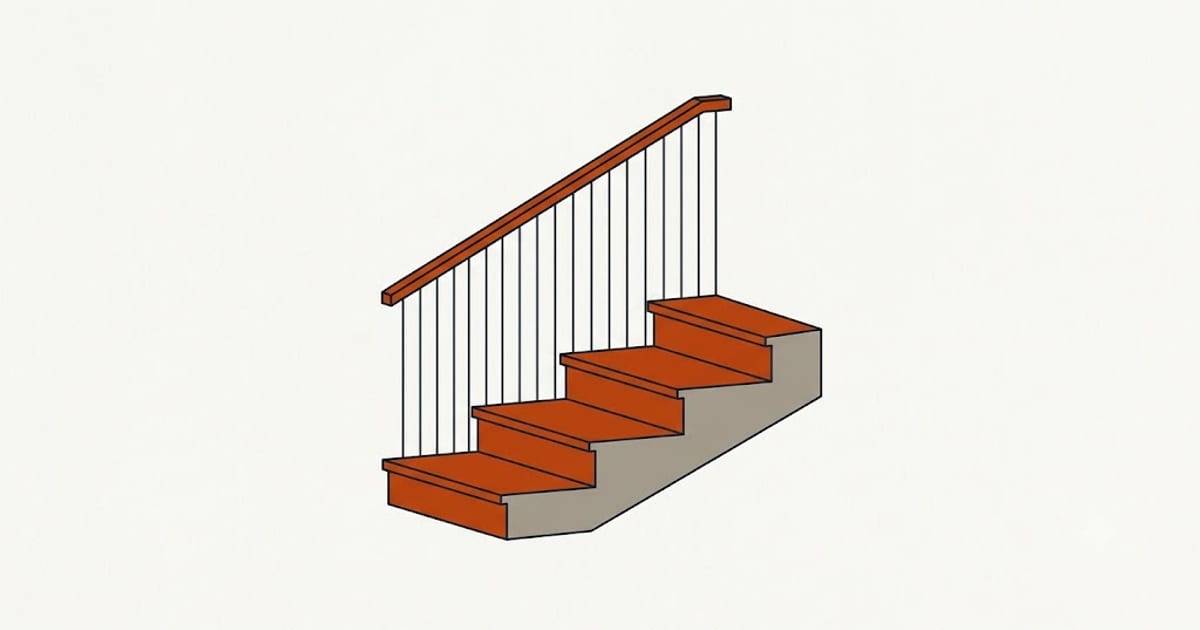
Stair railing is the most expensive linear foot on a deck. It is also the part most tightly governed by code, and the two facts are related — almost everything that makes it expensive is there because a rule requires it.
Cost per linear foot, installed
| System | Material only | Installed |
|---|---|---|
| Pressure-treated timber | $8–16 | $25–45 |
| Cedar | $14–25 | $35–60 |
| Composite (matching decking) | $25–45 | $50–90 |
| Aluminium | $30–55 | $60–100 |
| Cable rail (stainless, timber posts) | $60–110 | $110–180 |
| Glass panel | $90–170 | $160–280 |
Stair railing runs 20–40% more per foot than level railing on the same system. Every picket is a different length, every cut is an angle, and the terminations at top and bottom are one-off details.
Two rules that decide the design
1. Baluster spacing — the 4-inch sphere. A 4" sphere must not pass through any opening. On a stair the rule is measured on the sloped opening, so balusters that pass on the level deck can fail on the flight. Spacing usually works out at 4½–5" on centre for 1½" balusters.
There is a second sphere rule people miss: at the triangular opening formed by the tread, riser and bottom rail, the limit is a 6" sphere, not 4.
2. Graspability. A stair with four or more risers needs a graspable handrail — 34–38" above the tread nosing, and either 1¼–2" round, or a shaped profile the code permits. A 2×4 laid flat on top of the posts is not graspable, and it is the single most common reason a deck fails inspection.
That handrail is in addition to the guard, which is what the balusters belong to. On many builds it means a separate graspable rail mounted on the posts under the top rail, and that is a real line of cost people do not price.
| Requirement | Residential |
|---|---|
| Guard height, stairs | 34–38" from tread nosing |
| Guard height, deck | 36" (42" some jurisdictions) |
| Baluster opening | < 4" sphere |
| Triangular opening at tread | < 6" sphere |
| Graspable handrail | 4+ risers |
| Post spacing | ≤ 6 ft, and tighter for cable |
Check the local amendment. Guard height on the deck itself is 36" in the IRC and 42" in a number of jurisdictions, and it is not a detail you can fix afterwards.
Worked example
A 5 ft wide flight, 8 risers, railing both sides:
- Flight length on the slope ≈ 8 risers × 7¾" rise → ~10 ft of sloped run each side = 20 linear ft
- Composite at $50–90 installed = $1,000–1,800
- Plus two extra posts and a graspable rail either side
Twenty feet of railing on a stair costs about what forty feet costs on the flat. Worth knowing before comparing two quotes where one included stairs and one did not.
Where cable rail costs more than the price list says
Cable is priced per foot and then hits you at the posts. Cable tension is high — roughly 200–300 lb per run — so intermediate posts must resist it without deflecting. On timber posts that usually means 4×4 becomes 4×6, or steel inserts, and runs longer than about 4 ft need intermediate spacers to stop the cables spreading under the 4" sphere test.
Budget for the frame, not the cable. On a stair with two flights it is often the posts, not the cable, that make the quote.
Cheapest compliant build
Pressure-treated posts and rails, 2×2 balusters at 4½" on centre, and a separate round graspable handrail on the inside face. Around $25–45 per foot installed, it passes both sphere rules and the graspability rule, and it can be upgraded later without touching the stair framing underneath.