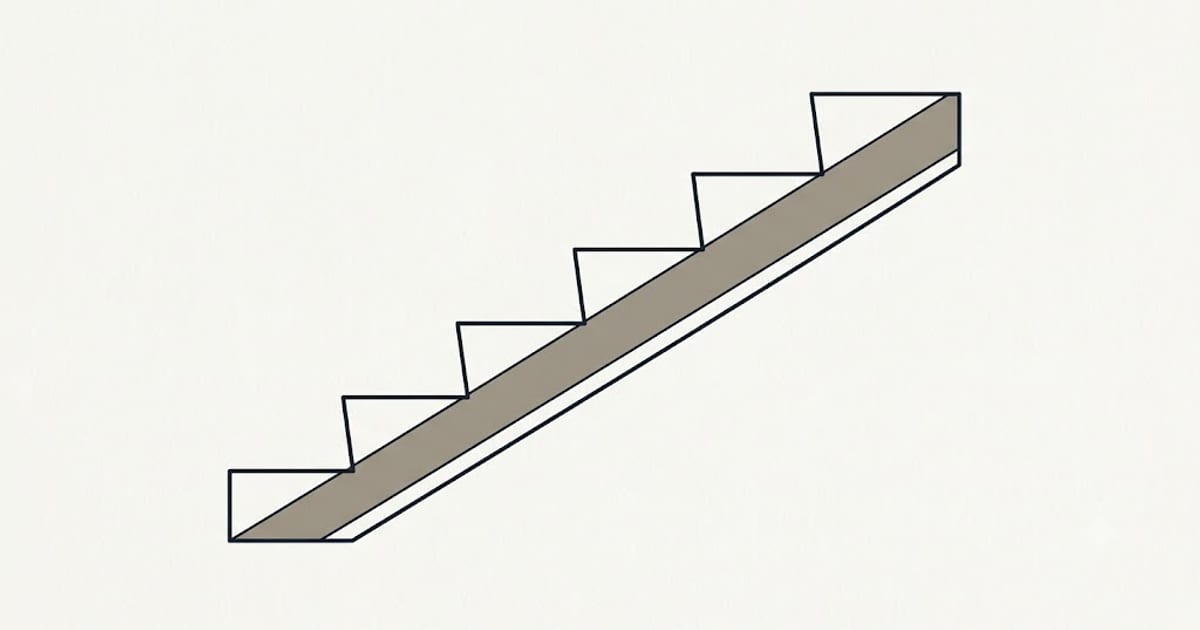
A stair stringer is a 2×12 with a saw-tooth cut into its upper edge. What is left behind those teeth carries the entire stair, and the two errors that ruin a set of stringers both come from forgetting that.
Start from total rise
Measure from the finished deck surface to the finished landing surface. Finished on both ends: if the pad has not been poured yet, its thickness has to be in the number now.
Total rise ÷ 7.75 (the IRC maximum riser), rounded up, gives the riser count.
44 in ÷ 7.75 = 5.68 → 6 risers 44 ÷ 6 = 7.333 in actual rise
Six risers means five treads on a stair that lands on a pad — the deck surface itself is the top of the sixth riser.
Run: at 10 in minimum tread depth, five treads is 50 in of total run. With a 1 in nosing on 2× treads, laying out at 10.5 in of run per step is common and comfortable, giving 52.5 in.
Mark it with a framing square
Set stair gauges on a framing square at the rise on the tongue and the run on the blade, then step the square along the board, marking each notch against the previous one.
Marking each notch independently from a tape measure accumulates error, and the IRC allows only 3/8 in of variation between the tallest and shortest riser in the flight. Stepping the square is what keeps every riser identical by construction.
Drop the bottom riser
This is the error that ruins more stringers than anything else.
When the stringer is cut, the bottom notch is a full riser height above the ground. But the treads sit on top of the horizontal cuts, so every step's finished height is one tread thickness above where it was marked — except the bottom one, which is measured to the ground.
The result: every riser is 7.333 in, and the bottom riser is 7.333 in plus the tread thickness. On a 1.5 in tread that is 8.8 in, which fails inspection and trips people.
Fix: cut the bottom of the stringer shorter by exactly one tread thickness. Every riser then measures the same in the finished stair.
Keep the throat
The throat is the perpendicular distance from the inside corner of a notch to the back edge of the board. It is the actual structural section of the stringer.
Minimum is 5 in, and it is a code requirement in most jurisdictions.
A 2×12 is 11.25 in wide. Cut a 7.333 in rise and a 10.5 in run and the notch diagonal eats a large part of that. Work it out before cutting: the throat is what is left after the notch, measured square to the stringer's back edge.
With a steeper rise and a deep tread it is easy to drop under 5 in without noticing, and there is no repair — the board is scrap. Cut one stringer, check the throat, then use it as the template for the rest.
Stringer spacing
Set by what the treads can span, not by the stringer:
| Tread material | Max stringer spacing |
|---|---|
| 2× lumber tread | 24 in o.c. |
| 5/4 PT, cedar | 16 in o.c. |
| Composite | 16 in, many require 12 in |
| Composite, diagonal | 12 in |
A 36 in wide stair in 5/4 decking takes three stringers. The same stair in a composite requiring 12 in takes four. Manufacturers publish this and it governs over the lumber figure — read the box before buying the boards, because the stringer count is set by that line.
Attaching top and bottom
At the top, hang the stringers from the deck's rim with stringer hangers, or bolt to a securely fastened ledger. Toenailing a stringer to a rim joist is the standard failure.
At the bottom, on a concrete pad, use a galvanised angle bracket with a concrete anchor. The bracket resists the stringers kicking outward — which is what a set of stairs wants to do under load, and what pulls the top connection apart.
The bottom of the stringer must not sit in soil or standing water. On a stair landing on gravel, that means a precast pier or a poured pad, not the ground.
The rules the inspector measures
Riser height, tread depth, the 3/8 in consistency rule, handrail height and graspability, and guard height on the open side. All of them are in the rise and run requirements, and all of them are pass-or-fail measurements rather than judgement calls.
Guards on the stair follow the deck's guard rules — including the 6 in sphere rule for the triangle formed by tread, riser and bottom rail, which is the one people fail after passing everything else.
Buy one extra 2×12
Stringers are the one part of a deck where a single mis-measurement scraps a whole board, and a 16 ft 2×12 is roughly $45. Cut, check the throat, check the bottom drop, then cut the rest.