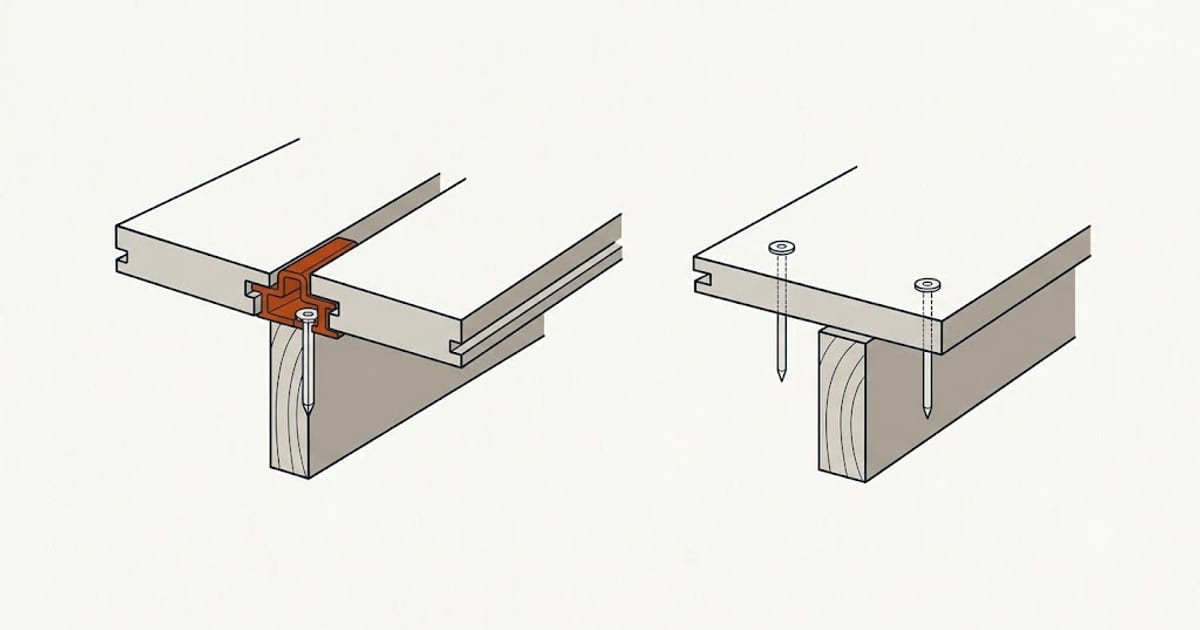
Face screwing puts two visible screw heads across every board at every joist. Hidden fastener systems put the connection in the board's edge or under its face, and the finished deck has an unbroken surface.
That is the whole aesthetic argument, and it is real. The rest is trade-offs.
The systems
Edge clips into grooved boards. The most common. Boards come with a machined groove in each edge; a clip sits in the groove of one board, screws to the joist, and its other wing captures the next board. The clip usually sets the gap spacing automatically.
Biscuit systems. A similar idea using a wider biscuit-shaped connector, slightly more forgiving on board straightness.
Screw-and-plug. Face screws driven through a counterbore, then a plug of the same material glued over each. Common on hardwood and on capped composite where colour-matched plugs exist.
Underside brackets. Fastened from beneath, so nothing touches the board's top or edge. Excellent result, and it requires access under the deck for the entire installation, which rules out most ground-level decks.
Cost per square foot
| Method | Fastener cost / ft² | Board premium | Total added |
|---|---|---|---|
| Face screws, coated | $0.28 | — | $0.28 |
| Face screws, 305 stainless | $0.75 | — | $0.75 |
| Edge clips | $0.85–1.30 | $0.20–0.50 for grooved | $1.05–1.80 |
| Screw and plug | $0.60–0.95 | — | $0.60–0.95 |
| Underside brackets | $1.40–2.10 | — | $1.40–2.10 |
On a 192 ft² deck, clips add roughly $150–290 over face screwing. Against a $2,500 composite deck that is 6–10% for the appearance, which most people who chose composite consider worth it.
Speed
Face screwing is faster, and by more than people expect. A clip system takes a clip at every joist for every board — the same number of fastening operations as face screwing, plus seating each board into the previous row's clips, plus the boards not being able to flex into place because the clips hold both edges.
Figure 20–35% longer for clips on a straightforward rectangular deck, and considerably more on anything with angles, because a board cut at an angle has no groove on the cut end.
Screw-and-plug is slower still: drill, drive, glue, plug, and on some products trim the plug flush.
The repair problem
This is the argument that decides it for most people, and it is rarely raised at the point of sale.
With face screws, removing one board in the middle of a deck is two minutes: back out the screws, lift the board.
With edge clips, each board is captured on both edges by clips fastened under the adjacent boards. Removing a board in the middle means either working back from the nearest edge, board by board, or destroying the board being removed and cutting the clips out.
Composite decks do get damaged — a dropped grill, a heavy planter, a delivery. Budget the possibility.
The mitigation is worth doing at build time: face-screw the last board or two at the outer edge, so there is a starting point to work back from. It costs nothing and it turns a whole-deck operation into a localised one.
Where each one belongs
Face screws — pressure-treated and cedar decks, any deck likely to be repaired, any deck built by one person in a weekend, and anywhere budget matters. On PT the screw heads weather to match the wood within a season anyway.
Edge clips — capped composite and PVC, where the board surface is the product being paid for and screw heads through a factory cap look wrong. Also the right answer wherever the boards will never need to be individually removed.
Screw and plug — hardwood decks. Ipe and cumaru need pre-drilling regardless, so the counterbore is nearly free, and plugs in matching wood are close to invisible.
Underside brackets — raised decks with full access underneath, and rooftop or dock applications where nothing may penetrate the top surface.
Both need the same things underneath
Neither system changes the joist spacing the boards require — composite still wants 16 in perpendicular and 12 in diagonal — and neither changes the gapping the material needs for expansion.
And neither one lets you skip counting. Clips are sold by the square foot on the box, but that figure assumes 16 in joist spacing, so a 12 in frame needs a third more than the box says. The face-screw count is the sanity check: one clip per joist per board is the same population as half the screws.