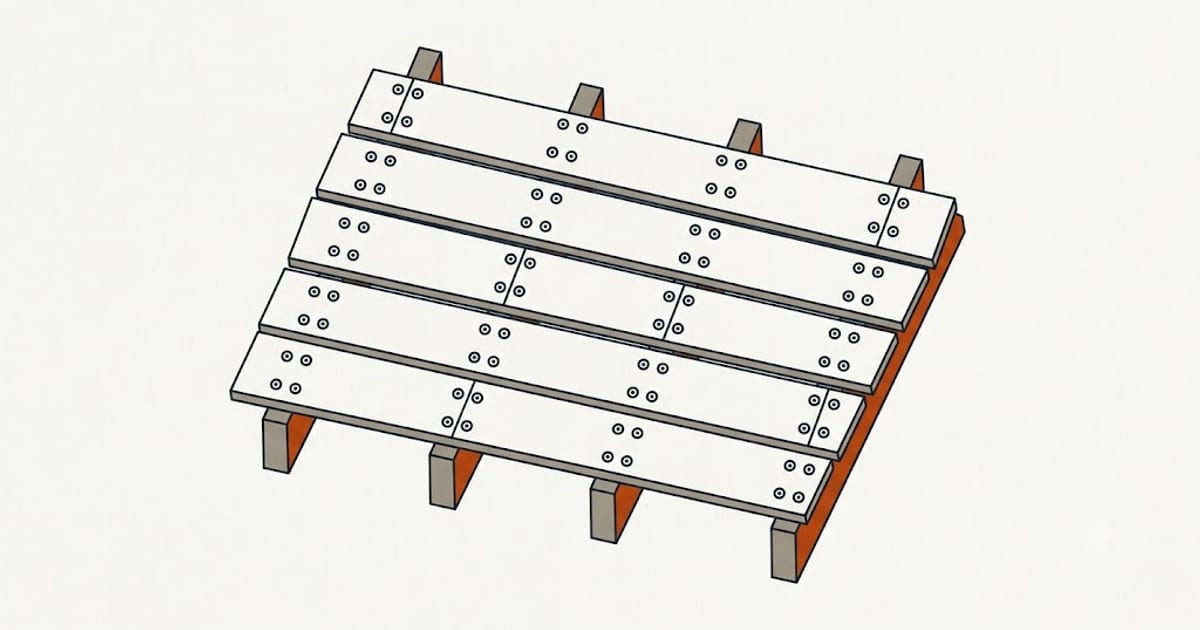
Deck fastener counts are simple arithmetic that nobody does until they are at the till, and the answer changes the shopping list by a box or two.
The count
The rule is two screws per board at every joist crossing. Two, not one — a single screw lets the board pivot and cup.
For 5/4 × 6 decking (actual face width 5.5 in) with a 1/4 in gap, each board occupies 5.75 in. Twelve inches of deck width takes 2.09 boards.
At 16 in joist spacing, each square foot has 0.75 joist crossings per foot of board run. Multiply through:
screws/ft² = (12 ÷ 5.75) × (12 ÷ 16) × 2 = 3.13
| Joist spacing | Screws per ft² | Per 100 ft² |
|---|---|---|
| 24 in o.c. | 2.09 | 209 |
| 16 in o.c. | 3.13 | 313 |
| 12 in o.c. | 4.17 | 417 |
Add 10% for stairs, the perimeter fascia, blocking and the ones that snap or strip. Call it 350 per 100 ft² at standard spacing.
A 12 × 16 ft deck is 192 ft², so about 670 screws. Screws sell in 350-count and 700-count boxes at 2.5 in — one large box does it with a little to spare.
Diagonal decking at 45° uses the same per-square-foot figure but needs 12 in joist spacing, which puts it in the bottom row: about 800 screws for the same deck, plus the extra joists to fasten to.
Length
Enough to penetrate the joist by at least 1 in, and 1.5 in is better:
| Decking | Actual thickness | Screw |
|---|---|---|
| 5/4 board | 1 in | 2.5 in |
| 2× decking | 1.5 in | 3 in |
| Composite, 1 in | 0.94 in | 2.5 in composite screw |
| Hardwood, 1 in | 0.75–1 in | 2.5 in, pre-drilled |
Longer is not better. A 3.5 in screw in a 5/4 board buys nothing and is more likely to split a joist near its edge.
Coating is the decision that matters
Modern pressure-treated lumber uses copper-based preservatives — ACQ, MCA, CA-C. Copper against steel in wet wood is a galvanic couple, and it eats ordinary fasteners.
| Fastener | Rated for PT? | Realistic life |
|---|---|---|
| Bright / zinc-plated | No | 2–5 yr |
| Hot-dip galvanised, ASTM A153 | Yes | 15–25 yr |
| Ceramic / polymer coated, PT-rated | Yes | 15–25 yr |
| Type 305 stainless | Yes | 40+ yr |
| Type 316 stainless | Yes, coastal | 40+ yr |
Zinc-plated screws in treated lumber are the reason a deck's boards come loose long before they rot. They are also the cheapest box on the shelf, and they are frequently sold beside the deck boards with nothing to say they are wrong.
Coastal, or any deck within about a mile of salt spray, wants 316 stainless. It roughly triples the fastener cost — perhaps $200 on this deck — and it is the difference between fasteners that outlive the boards and fasteners that stain every board head with rust in three summers.
Composite has its own rules
Composite screws have a reverse-thread section under the head that clears the mushroom of material a normal screw pushes up. Using a wood screw in composite leaves a raised ring around every hole across the entire deck.
Most composite also wants pre-drilling within 2 in of a board end, and manufacturers publish gapping requirements that change with installation temperature — gap spacing by material covers those, and getting them wrong on a hot day causes buckling on the first cold night.
Face screws or hidden fasteners
The 313 per hundred square feet above assumes face screwing. Hidden fastener systems change both the count and the cost substantially, and they have a real drawback at repair time — the comparison is worth reading before buying boards, because most hidden systems require a grooved board and that decision is made at the lumber yard.
Drive them properly
Set the head flush, not countersunk. A dimpled head in a deck board is a small bowl that holds water directly over the fastener hole, and the fastener hole is the shortest path into the joist below.
That path is the reason joist tape exists, and if the boards are off for any reason it is the cheapest thing you will ever do for the frame's life.