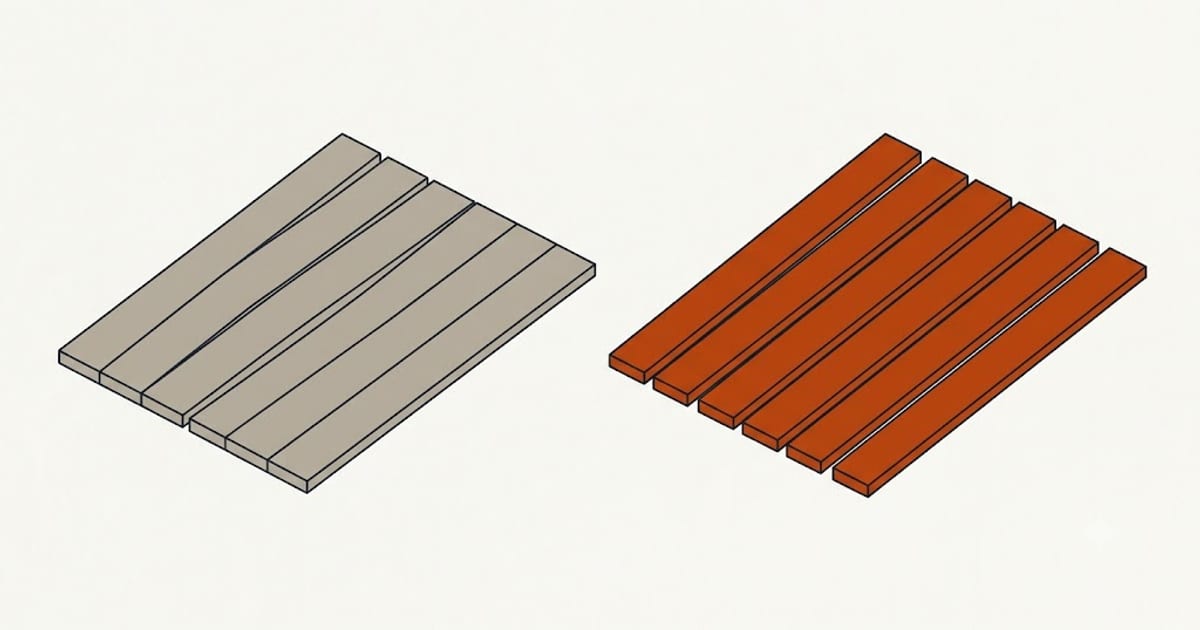
The gap between deck boards is not a style choice. It is a prediction about which way the board is going to move, and the two common materials move in opposite directions.
Pressure-treated goes down tight
Pressure-treated lumber is sold wet — it comes out of the treatment cylinder saturated and it is often still dripping on the rack. As it dries in service it shrinks across its width, typically ¼ inch on a 5½-inch board.
So it goes down at about ⅛ inch, or tight enough that a 16d nail just passes between boards. By the following summer that becomes a ⅜ inch gap on its own.
Install wet PT with a ¼-inch gap and you end up with gaps near ½ inch — wide enough to lose keys, a phone and small tools through, and wide enough that the deck reads as badly built.
Composite goes down with a gap
Composite is a manufactured board with thermal expansion along its length far more than its width. It arrives at whatever temperature the yard was, and it will see 40 °C swings in service.
Every manufacturer publishes an end gap by installation temperature — typically ⅛ to ¼ inch at the ends and a side gap of ¼ inch, sometimes more for dark colours.
Install composite tight in December and it buckles in July. This is the single most common composite failure and it is entirely an installation issue, not a product one.
Read the specific brand's instruction. The numbers vary by product and they are not interchangeable.
Cedar, redwood and hardwood sit between
Cedar and redwood are sold dry and move relatively little. Ipe and other dense tropicals are sold dry and are extremely stable, but they are also so dense that they need pre-drilled fasteners.
Both go down at roughly ³⁄₁₆ inch, which is a real gap on day one and stays close to it.
The number that decides board count
What sets how many boards a deck takes is neither the nominal width nor the gap alone. It is the repeat — actual width plus gap.
| Board | Actual width | Typical gap | Repeat |
|---|---|---|---|
| 5/4×6 PT | 5½″ | ⅛″ wet | 5⅝″ |
| 2×6 PT | 5½″ | ⅛″ wet | 5⅝″ |
| Composite 5.5 | 5½″ | ¼″ | 5¾″ |
| Cedar 5/4×6 | 5½″ | ³⁄₁₆″ | 5¹¹⁄₁₆″ |
| Ipe 1×6 | 5½″ | ³⁄₁₆″ | 5¹¹⁄₁₆″ |
A 12 ft wide deck is 144 inches. At a 5⅝″ repeat that is 25.6 rows; at 5¾″ it is 25.0. Rounding the wrong way at the order stage is one board, and one board is rarely the problem — assuming a 6-inch board is 6 inches wide is, and that error is 9% across the whole deck.
Board counts by deck size, material and layout work from the repeat rather than the nominal.
Gapping the ends
Butt joints need a gap too, and the same logic applies: PT tight, composite per the instruction. Both need the joist doubled underneath so each board lands on its own half — a butt joint on a single joist gives each board about ¾ inch of bearing, which is not enough for either.
Stagger the joints so no two adjacent rows meet over the same joist, and remember that joist spacing is often set by the decking rather than the span table.
Around the perimeter
Leave a gap where decking meets the house, a post, or anything else fixed — including at the ledger, where a tight board traps water against the one connection that must never rot. Boards need somewhere to go, and a board wedged against a post is the one that lifts first.
Two habits worth having
Bark side up. A board cups away from its bark side, so bark-up sheds water off the crown instead of holding it in a trough. Read the end grain: the arcs curve away from the bark.
Two screws at every crossing. One screw lets the board rotate and lift at the corner, and it is the most common reason a deck looks tired after two summers.