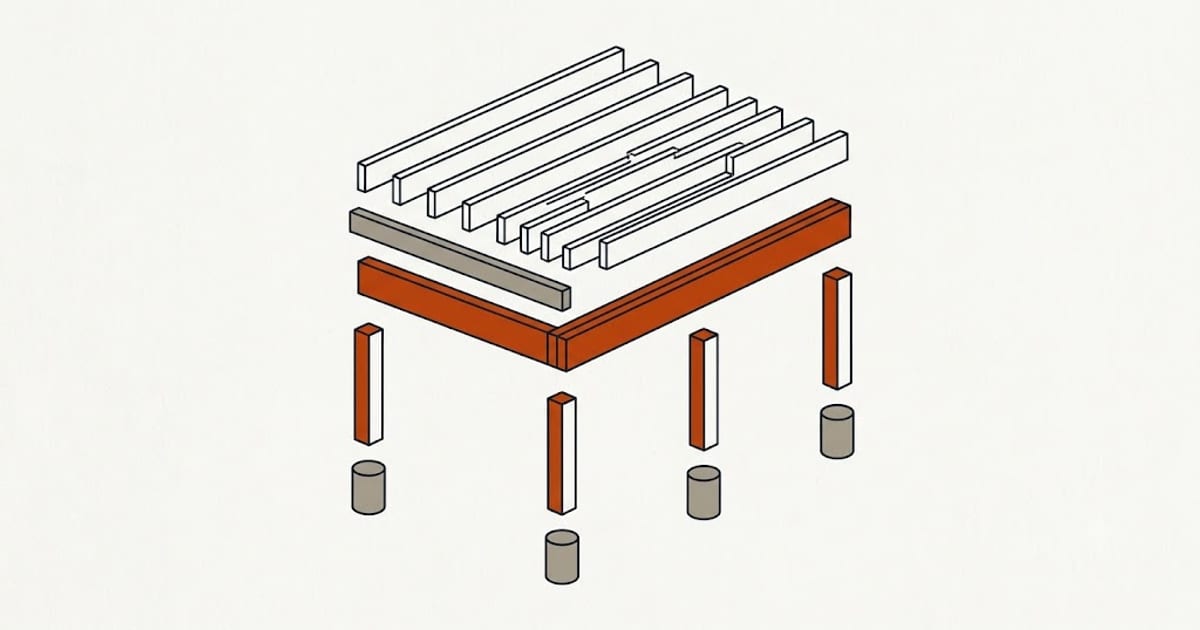
A deck's cost splits roughly into framing, decking and railing. The decking and railing get quoted by the square foot and the linear foot, so people compare them. The frame gets quoted as a lump, so nobody does.
Here it is opened up, for a 12 ft × 16 ft deck attached to a house, 3 ft above grade, in pressure-treated southern pine at 2026 retail prices. Scale it by area for other sizes; the structure does not change.
Layout the tables give you
Joists run the 12 ft direction, at 16 in on centre. A 2×8 southern pine joist at 16 in o.c. spans 13 ft 1 in, so 12 ft is comfortable and 2×8 is the correct size — 2×10 here is money spent on nothing.
That is 13 joists (16 ft ÷ 16 in = 12 bays, plus one), each 12 ft.
The beam carries 12 ft of joist. From the beam span table, a doubled 2×10 southern pine beam carrying 12 ft of joist spans 6 ft 8 in, and a tripled 2×10 spans 8 ft 6 in. With a 16 ft run, a tripled 2×10 gives three posts at 8 ft centres; a doubled 2×10 needs four.
Three posts is cheaper than four once the footings are counted, so the beam gets the third ply.
The take-off
| Line | Qty | Unit | Total |
|---|---|---|---|
| 2×8 × 12 ft joist, PT | 13 | $19 | $247 |
| 2×10 × 16 ft beam ply, PT | 3 | $34 | $102 |
| 2×8 × 16 ft rim / ledger | 3 | $26 | $78 |
| 6×6 × 8 ft post, PT | 3 | $42 | $126 |
| Joist hangers, 2×8 | 26 | $1.60 | $42 |
| Hanger nails / structural screws | 1 box | $38 | $38 |
| Post base brackets | 3 | $16 | $48 |
| Post-to-beam caps | 3 | $19 | $57 |
| 1/2 in ledger through-bolts + washers | 14 | $3.20 | $45 |
| Ledger flashing, 10 ft | 2 | $17 | $34 |
| Concrete, 60 lb bags | 21 | $6.40 | $134 |
| Sonotube, 12 in × 4 ft | 3 | $22 | $66 |
| Framing subtotal | $1,017 |
That is $5.30 per square foot of deck, framing only — before a single deck board, and before railing, stairs, permit or labour.
What moves the number most
Post height. A deck 3 ft up uses 8 ft posts and needs no bracing. A deck 8 ft up uses longer posts, knee bracing at every post, and in most jurisdictions a lateral load connection — call it another $300–500 on this deck. Height is the single most expensive variable in deck framing and it is set by the house, not by choice.
Species. Hem-fir is 15–20% cheaper per board and spans less, so a hem-fir frame often needs 2×10 joists where southern pine took 2×8. The saving mostly evaporates. Check the grade stamp before pricing.
Ground-contact rating. Posts and anything within 6 in of grade must be rated for ground contact (UC4A), which costs 20–30% more than above-ground PT. Buying above-ground material for posts is a common and expensive error, because it fails at the base in eight years.
Footing depth. Three 12 in piers at 42 in deep is 21 bags. The same piers in a 60 in frost zone is 30 bags and three extra tubes. Frost depth is a jurisdiction number and it moves the concrete line by half.
What this is not
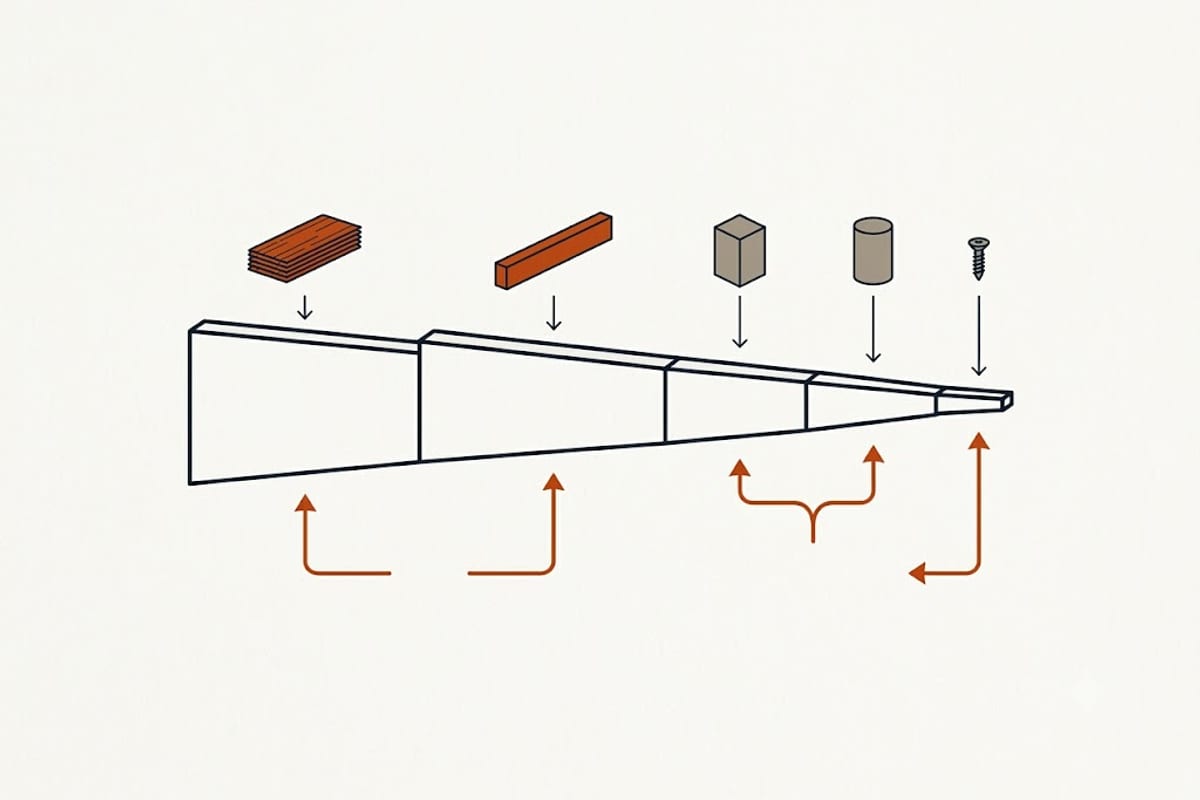
It is not the deck. Adding 5/4 pressure-treated decking at $2.10 per square foot, plus a 34 linear foot railing at $28 per foot, plus a 4-step stair, roughly doubles the material total to $2,900 — and labour on a deck of this size typically runs $3,500–5,500 on top.
The full picture is in the per-square-foot build cost, and the decking choice on its own is worth the twenty-year comparison.
Order one extra of the long items
Not as contingency — as a hedge against crown. Pressure-treated lumber arrives wet and some of it is bowed badly enough to reject on sight. One extra joist and one extra beam ply is $53 and saves a second trip, which on a weekend build is the difference between finishing and not.