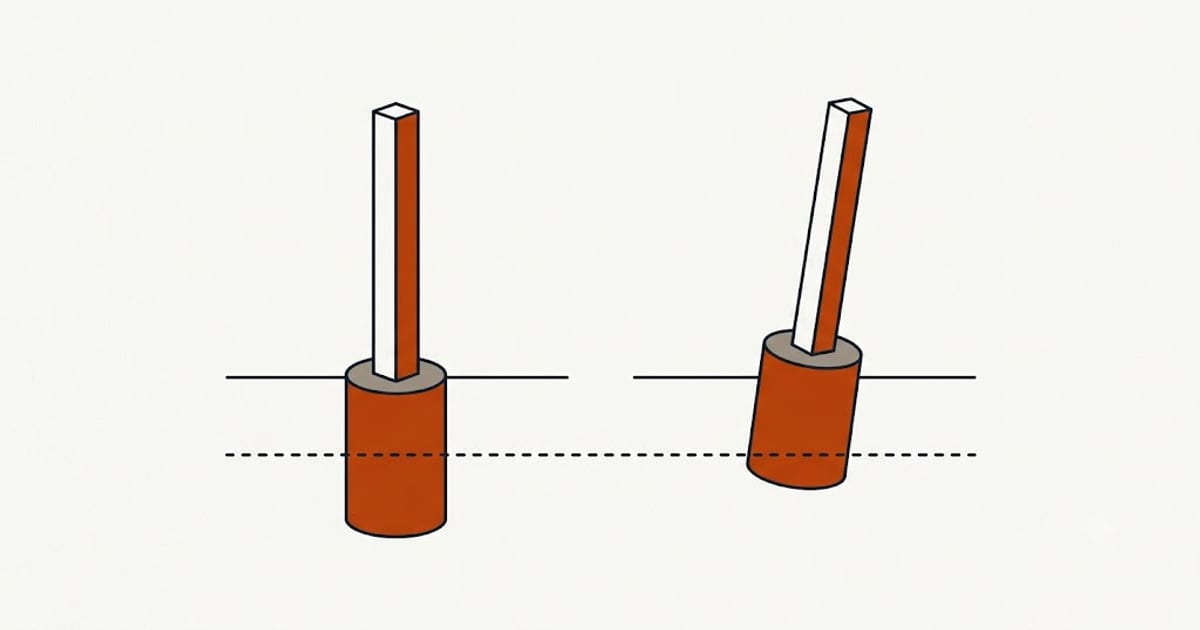
Frost depth is the depth to which soil freezes in a normal winter in a given place. Footings go below it. That is the entire rule, and it is the one deck detail that is genuinely non-negotiable.
Why it is a jurisdiction number
Frost depth is adopted by the local building department, not by the state, and neighbouring towns sometimes differ. It is based on local frost penetration records plus a safety margin, and it is written into the local amendments to the code.
Which means every table you find online — including this one — is a planning range. The number you build to comes from one phone call.
| Region | Typical adopted depth |
|---|---|
| Gulf Coast, Florida, coastal Southern California | 0–12 in |
| Carolinas, Georgia, Tennessee, Arizona | 12–18 in |
| Virginia, Kentucky, Missouri, Oklahoma | 18–30 in |
| Pennsylvania, Ohio, Indiana, southern New England | 30–42 in |
| Michigan, Wisconsin, Iowa, New York, Colorado | 42–48 in |
| Minnesota, the Dakotas, northern Maine, Montana | 48–72 in |
Elevation moves this substantially inside a single state. A Colorado mountain town can adopt 60 in while Denver adopts 36.
What frost heave actually does
The common mental picture is ice pushing up under the footing. That is not the main mechanism.
Water in soil freezes and expands about 9%, but the destructive process is ice lensing: as a freezing front advances downward, it draws additional water up to it by capillary action and grows horizontal lenses of ice. Those lenses can lift the ground surface several inches.
The lifting force is applied to the sides of the pier by adfreeze — soil frozen to the concrete grips it and carries it up. Then, in spring, the soil thaws and settles but the pier does not go all the way back. Debris falls into the gap beneath it. The next winter it lifts a little further.
This is why a deck heaves a bit more every year rather than snapping back, and why the door onto it stops closing in year three.
Two consequences people miss
Depth is measured to the bottom of the footing, not the top of the pier. A pier whose top is 6 in below grade and whose bottom is at 30 in, in a 42 in zone, is a heaving footing.
A smooth pier resists adfreeze better than a rough one. A cardboard tube left in place, or a slick plastic form, gives frost less to grip than a hole augered into clay and filled loose. In severe zones a smooth form is worth the material.
Soil type changes the risk, not the requirement
Silt is the worst frost-susceptible soil — fine enough to wick water strongly, coarse enough to let it move. Clay heaves less than silt. Clean sand and gravel drain and barely heave at all.
But the adopted depth is the adopted depth, and an inspector will not accept "it is gravel here" as a substitute. What good drainage buys is margin, not exemption.
Where deep digging is impractical
Helical piles. Screwed down to a certified torque, well below frost, with a shaft that gives frost very little to grip. Installed in an hour by a machine, and priced at three to five times a poured pier — $400–800 each installed. They earn it on rocky ground, on steep sites, on wet ground, and anywhere a mixer cannot reach.
Frost-protected shallow foundations. Rigid insulation extending horizontally out from the footing to keep the ground beneath it above freezing. Standard practice for heated buildings; only usable on a deck adjacent to a heated structure, and unusual enough that it needs an engineer and a receptive inspector.
Floating on grade. Legitimate for a freestanding, unattached deck under 30 in high on precast piers, in jurisdictions that permit it. It heaves and settles with the ground. Because nothing connects it to the house, that movement is a nuisance rather than a failure — and the moment a ledger goes on, this option is gone, because the deck must move with the house and the house is on a frost-depth foundation.
Concrete per hole, by depth
The bags line moves more with frost depth than with anything else on the job.
| Diameter | 24 in deep | 42 in | 60 in |
|---|---|---|---|
| 12 in | 4 bags | 7 bags | 10 bags |
| 15 in | 6 bags | 10 bags | 15 bags |
| 18 in | 9 bags | 14 bags | 20 bags |
Diameter comes from soil bearing and tributary load; depth comes from here. Multiply the two before pricing, because on a northern deck the concrete line is often larger than the beam line in the framing take-off.
Before you dig
Call the building department for the adopted depth, and call the utility locate line. The first is a number that changes the whole material order; the second is free and takes one call.