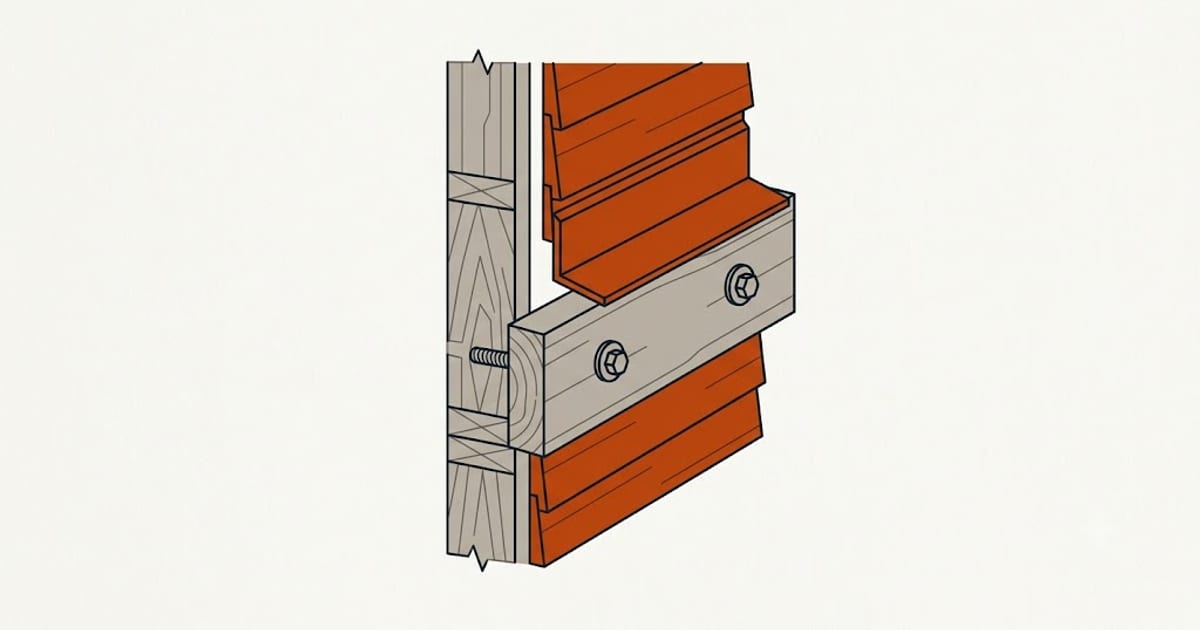
Deck collapses are almost never joist failures. They are ledger failures, and they happen in one of four ways: nailed instead of bolted, fastened into siding instead of structure, fastened into rotten sheathing, or never flashed so the structure rotted from above.
The code section is IRC R507.9, and it is short.
Nails are not acceptable. Ever.
The ledger carries half the entire deck load, and it carries it in shear — trying to slide down the wall. Nails have very little shear capacity and less withdrawal capacity, and they loosen over years of seasonal movement.
The permitted fasteners are ½-inch through-bolts or ½-inch lag screws into the band joist, or a structural screw specifically listed for ledger attachment with its own evaluation report and its own spacing table.
Deck screws, construction screws, framing nails and anything from a nail gun are not on that list.
Spacing depends on joist span
The longer the joists, the more load per foot of ledger, and the tighter the fasteners.
| Joist span | ½″ lag or bolt spacing |
|---|---|
| 6 ft | 30″ |
| 8 ft | 23″ |
| 10 ft | 18″ |
| 12 ft | 15″ |
| 14 ft | 13″ |
| 16 ft | 11″ |
Representative of IRC Table R507.9.1.3 for a 2× ledger onto a 2× band joist. Structural screws follow their own manufacturer table, which is usually tighter.
Fasteners are staggered in two rows, kept back from the top and bottom edges of the ledger, and kept away from the ends — the code gives edge and end distances and they exist because a bolt too near an end splits the board along the grain.
What the ledger must bear on
The band joist of the house — solid framing, not sheathing, not siding, not brick veneer.
Brick veneer is not structure. A ledger bolted through brick into nothing is holding a deck up with mortar. Decks on brick houses are almost always freestanding, on their own posts, with no ledger at all — which means an extra row of footings rather than a cheaper deck.
Cantilevered floors — where the house floor overhangs its foundation — cannot take a ledger either. There is nothing behind the band joist to resist the pull.
Stucco and foam sheathing need the ledger held off the wall on stacked washers or a rated spacer, with the fastener sized for the extra gap. Compressing foam sheathing under a ledger is a slow failure.
Flashing is what keeps it from rotting
Water running down the wall meets the top of the ledger. Without flashing it sits there.
The detail: flashing over the top of the ledger, tucked up behind the housewrap or siding, so water runs down the wall, over the flashing, over the ledger, and out. Not under it.
Ledgers that were bolted correctly still fail, ten or fifteen years later, because the band joist behind them turned to compost. When a deck comes down and the bolts are still tight in the ledger, this is why.
Many builders also hold the ledger off the wall on washers to create a drainage gap, which lets the back of the ledger dry.
Lateral load anchors
The IRC also requires lateral load connections — hardware tying deck joists back to the house floor framing, resisting the deck pulling away rather than dropping. Usually two anchors, each rated 1,500 lb, or four at 750 lb.
They are cheap, they are code, and they are the most commonly omitted item on a deck permit inspection — alongside the guard and handrail triggers on the stairs.
How to check an existing deck in five minutes
- Look at the top of the ledger. Is there flashing, or is the ledger tight against the siding?
- Look at the fastener heads. Bolt or lag heads are hexagonal and obvious. Round nail heads mean the deck is held on by nails.
- Push a screwdriver into the band joist behind the ledger from underneath. If it sinks, the wood is gone.
- Look for hardware tying the joists back into the house.
Any one of those failing is worth acting on before the next gathering. This is the one deck detail where the failure mode is sudden and the deck is usually full of people when it happens.
Everything else on the deck — span, spacing, cantilever — only matters if this connection holds.