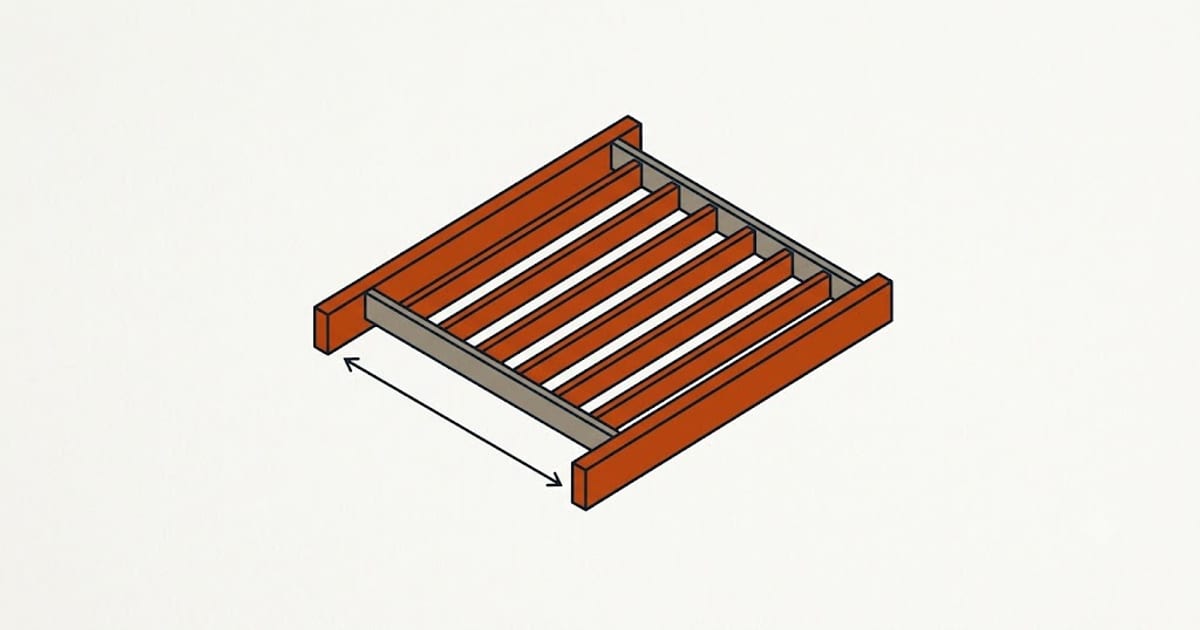
Deck joist spans come from IRC Table R507.5, and the table only means anything under four conditions:
- 40 psf live load plus 10 psf dead load — normal residential occupancy
- No. 2 grade lumber or better
- Wet service conditions — outdoor exposure, already accounted for
- No cantilever beyond the span shown
Break any one and the table stops applying. A hot tub, a heavy planter wall, a roof over the deck, or a high-snow jurisdiction all put you outside it — and outside it the answer comes from an engineer rather than a chart.
Species is worth about a foot
| Joist | Southern Pine | Doug Fir-Larch | Hem-Fir | Redwood / Cedar |
|---|---|---|---|---|
| 2×6 @ 16″ | 9′ 11″ | 9′ 6″ | 9′ 0″ | 8′ 10″ |
| 2×8 @ 16″ | 13′ 1″ | 12′ 6″ | 11′ 10″ | 11′ 8″ |
| 2×10 @ 16″ | 16′ 2″ | 15′ 8″ | 14′ 0″ | 14′ 11″ |
| 2×12 @ 16″ | 18′ 0″ | 18′ 0″ | 16′ 6″ | 17′ 5″ |
Representative values under the four conditions above. Your local amendment governs — check it before ordering.
Same size, same spacing, same code, and up to a foot of difference. Nobody at the lumberyard mentions which species is on the rack, and in most of the country you get whatever the region grows.
Ask what species the yard is selling before you size the joists, not after.
Spacing is the expensive way to buy span
Halving the spacing from 24″ to 12″ doubles the number of joists and buys perhaps two feet of span. Going up one size — 2×8 to 2×10 — usually buys more span for less money and much less labor.
The exception is when the decking dictates spacing. Most composite boards require 16″ on center for a straight layout and 12″ for a 45° diagonal. That is a decking decision that arrives as a framing cost, and it is the most common reason a deck gets reframed on paper halfway through planning.
What spans at what spacing, for every size and species is the fastest way to test a few combinations before committing.
Cantilever is a quarter of the actual span
Not a quarter of the maximum in the table. If the table allows 16 ft and your joists run 10 ft, the overhang is 2 ft 6 in, not 4 ft.
This is the single most misread line in the deck section of the code, and it is misread in the dangerous direction.
Deflection is why the table stops before the wood breaks
Span tables are limited by L/360 deflection, not by strength. A joist at its maximum table span is nowhere near breaking — it is at the point where the bounce becomes objectionable.
Which means a deck built exactly to the table is code-compliant and still feels lively when people walk across it. If bounce matters to you — and it does on a dining deck — go one size up or one spacing tighter than the minimum. It is the cheapest comfort upgrade available on the whole build.
Blocking between joists at mid-span stiffens the deck against the side-to-side roll that makes a deck feel unsteady. It is not a span increase and the table does not credit it, but it changes how the deck feels more than the numbers suggest.
What actually fails is the ledger
Span tables get all the attention. Ledger attachment is what kills people.
Most deck collapses are ledger failures — nailed instead of bolted, or fastened through rotten sheathing into nothing at all. IRC R507.9 specifies the fastener type and pattern, and flashing above the ledger is what prevents the rot that undoes it.
If you read one part of the deck code, read that one. The joist table only matters on a deck that is still attached to the house.
Before you order lumber
Pull the permit. Local codes amend the IRC and some jurisdictions use higher live loads or require specific hardware. Finding that out after the delivery is expensive in both directions — and it is a free phone call before.
Costs follow from the frame you settle on, not the other way round.