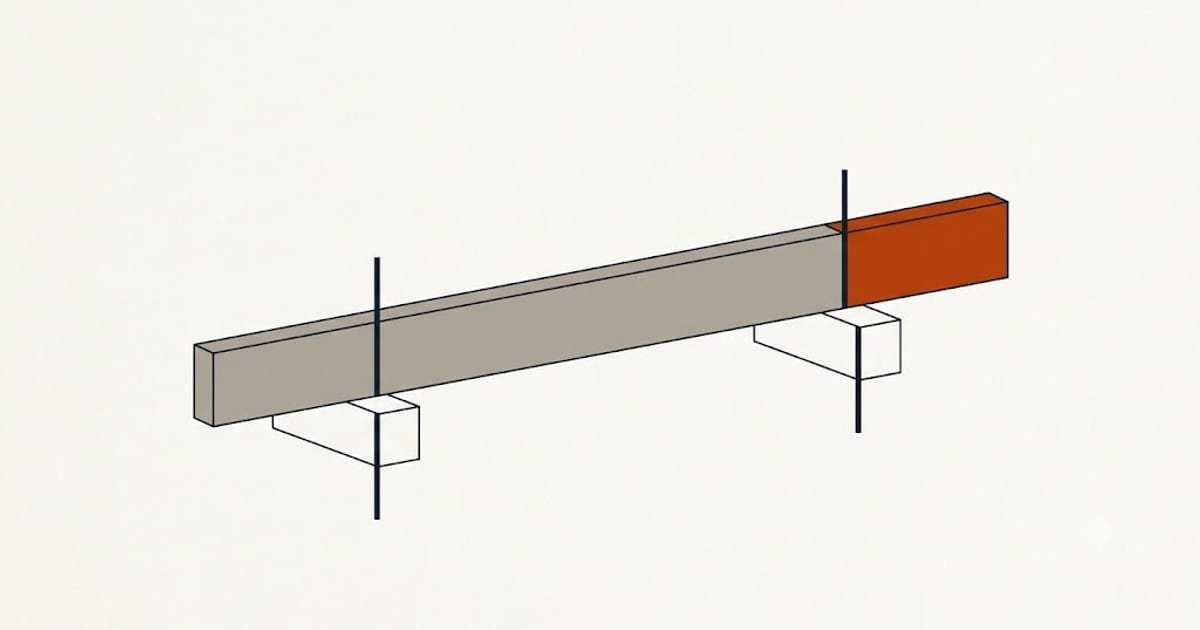
The rule reads simply enough: a deck joist may cantilever past its supporting beam by up to one quarter of its span.
The word doing the damage is span. It means the backspan you actually built — the clear distance from the ledger to the beam — not the maximum span the table would have permitted.
The difference, in numbers
A 2×10 Southern Pine joist at 16″ on center can span 16 ft 2 in under the table.
- If you build the backspan at 16 ft: cantilever up to 4 ft
- If you build the backspan at 10 ft: cantilever up to 2 ft 6 in
- If you build the backspan at 8 ft: cantilever up to 2 ft
The joist is the same joist. What changed is how much deck is holding the far end down.
Reading the table maximum and applying a quarter of it to a shorter deck is how a beam ends up too far inboard, and the symptom is a deck that lifts at the ledger when people stand at the edge.
Why the rule exists at all
A cantilever is a lever. Load on the overhang tries to rotate the joist over the beam and lift the ledger end. The backspan and the deck load on it are the counterweight.
Short backspan, long overhang, and the counterweight loses. That is the failure mode, and it is why the limit is a ratio rather than a fixed distance.
Beam cantilever is a different rule
Beams can overhang their posts too, and the limit there is generally one quarter of the beam span between posts, under IRC R507.5. Some jurisdictions cap it further.
A beam cantilever and a joist cantilever stack — a deck can have both, and each is measured against its own backspan.
What a cantilever buys you
One fewer row of footings — and footings are 10–15% of the build. Moving the beam inboard by 2 ft on a 12 ft deck means the footings are closer to the house, in ground already disturbed by the foundation, and often shallower to dig.
A cleaner edge. No beam or post visible at the deck perimeter, which matters visually on a low deck.
Shorter joists. A 14 ft deck with a 2 ft 6 in cantilever uses 12 ft joists, and 12 ft stock is cheaper per foot than 16 ft in most yards.
Where it goes wrong
Hot tubs and heavy loads on the overhang. The 40 psf live load assumption is exactly what a hot tub breaks. Nothing heavy goes on a cantilever without an engineer.
Stairs landing on the cantilever. Stair loads are concentrated and they arrive at the worst point. Stairs are supported from their own posts or from the beam, not from the overhang.
Guard posts on the cantilever end. A guard has to resist a 200 lb lateral load at the top rail, which puts a large moment into the joist end. Guard posts bolted to a cantilevered joist end need blocking and hardware designed for it — this is where a lot of otherwise sound decks are weak.
Decking overhang counted as cantilever. The boards can overhang the last joist by an inch or two for a clean edge. That is trim, not structure, and it is not part of the ratio.
Measure the backspan, then decide
The order matters. Fix the ledger, decide where the footings can go, and the backspan falls out of that. Then take a quarter of it.
Doing it the other way round — choosing the overhang first and finding the beam location afterwards — is how the ratio gets broken without anybody noticing.
Span tables for every size, species and spacing give the backspan limit; this rule gives what you can add past it. And the four assumptions behind the whole table have to hold for either number to mean anything.