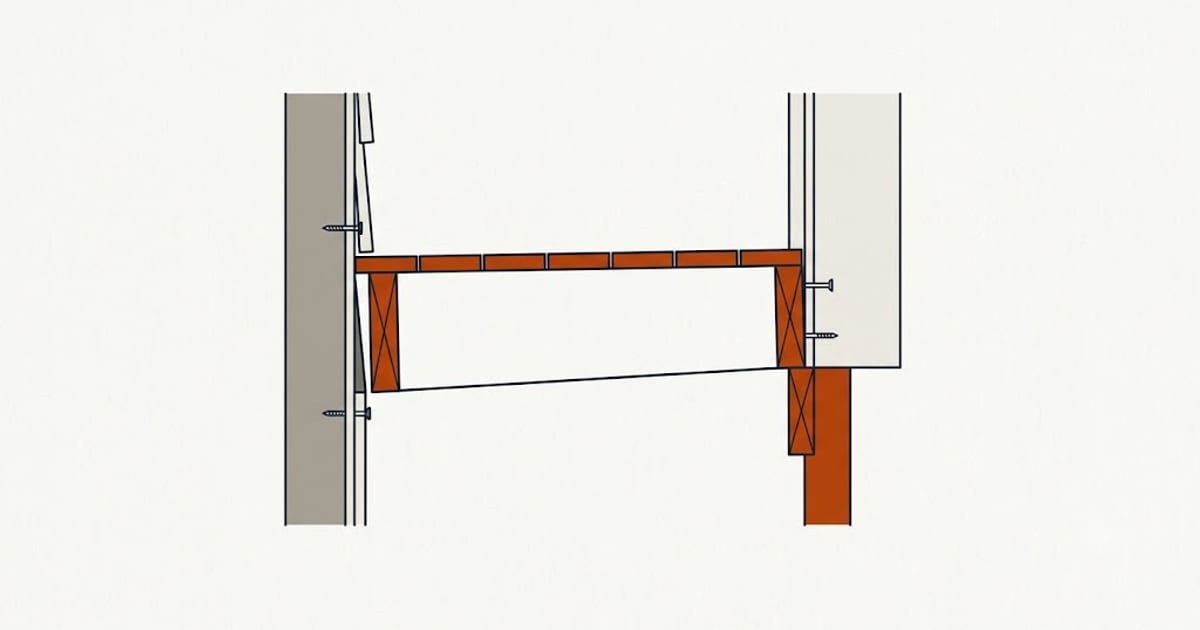
The failure that hurts people is not a soft board or a wobbly rail. It is the ledger — the board bolting the deck to the house — releasing all at once while the deck is full.
Order your inspection by that. Everything else can wait.
1. The ledger connection
Pull one deck board at the house wall, or get underneath with a light.
Nails instead of bolts ends the inspection. A nailed ledger is not a code-compliant connection and never was under any deck-specific provision. Nails withdraw slowly under repeated load, and the deck holds fine for years right up until it does not.
Look for 1/2 in lag screws or through-bolts in a staggered pattern, roughly every 8–16 in depending on joist span. Then look at what they are going into: solid rim joist is correct. Bolts landing in sheathing only, in brick veneer, or through a cantilevered floor overhang, are holding nothing.
The details are in the ledger attachment rules, and every one of them is checkable in ten minutes.
2. Flashing above the ledger
There should be metal flashing turned up behind the siding and out over the top of the ledger.
Without it, water runs down the wall, sits on the top edge of the ledger, and rots both the ledger and the house rim joist behind it. This produces the classic failure: bolts that are perfectly tight, in wood that has turned to fibre.
Probe the top edge of the ledger and the band joist behind it with a screwdriver. Anything you can push into more than a quarter inch is structurally gone.
3. Post bases
Probe the bottom 6 in of every post.
Posts set directly into the ground, or bearing directly on concrete with no gap, wick water into their end grain. They rot from the inside out and look sound from three feet away. A screwdriver pushed into the base tells you in one second.
Also check that each post is actually fastened to its footing. A post standing loose on a pier does nothing against uplift, and wind under a deck lifts it.
4. Beam-to-post connection
The beam should sit on top of the post, in a cap bracket or in a proper notch with through-bolts.
A beam fastened to the side of a post with screws or nails is carrying the entire deck load in fastener shear. This is common on older decks and on DIY builds, and it is the second most frequent structural defect after the ledger.
Look for splitting around the fasteners, and for the beam having settled visibly lower than where the fasteners sit.
5. Joists and hangers
Every joist should land in a hanger, and every hanger hole should have a fastener in it. Half-filled hangers are extremely common — the hanger is rated on the assumption every hole is filled.
Check the fasteners themselves: hanger nails or structural screws, not deck screws. Deck screws are brittle in shear and are not rated for hangers.
Then check for rust. Pre-2004 galvanised hardware paired with modern ACQ-treated lumber corrodes noticeably faster than it did with the older CCA treatment, and rusty hangers on a deck rebuilt in the last twenty years are worth replacing on sight.
6. Guards and stairs
Now the injury-rather-than-collapse items.
Guard height — 36 in minimum where the walking surface is over 30 in above grade. The 4 in sphere rule — no 4 in sphere may pass through any opening. Take a 4 in ball and try it, particularly at the bottom rail and where the guard meets the stairs. Guard rigidity — push hard, horizontally, at the top rail. Guards are required to resist a 200 lb concentrated load, and most failures are at the post attachment, where a 4×4 has been through-bolted through a single rim joist and split. Stair riser consistency — measure every riser. More than 3/8 in of variation across a flight is both a code failure and the most common cause of falls on decks. The rise and run rules give the limits.
7. Movement
Have somebody walk across the deck while you watch from underneath, then push sideways at the rail.
Bounce along the joists means an over-spanned joist — compare what is there against the span table. Side-to-side sway on a raised deck means missing bracing or a lateral load connection that was never installed.
What ends the inspection
A nailed ledger, a rotten ledger or band joist, or rotten post bases. Any one of those means the deck comes out of service now, not at the weekend. There is no partial repair for a ledger, and the failure mode gives no warning.
Everything else on the list is a repair. Those three are a rebuild, and the honest way to price one is the framing take-off against what resurfacing would have cost.