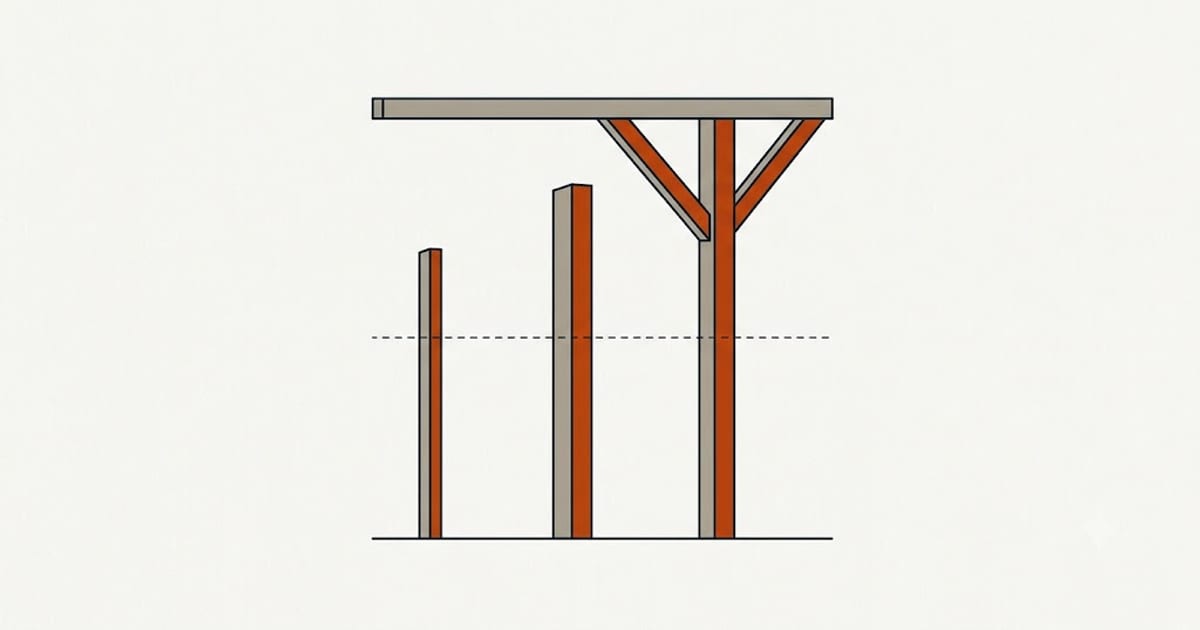
Deck posts fail in three ways: they crush, they buckle, or they rot at the bottom. Size addresses the second, the connections address the first, and the material rating addresses the third — and the third is what actually ends most posts.
Size against height
The current IRC gives post size as a function of unbraced height — the distance from the top of the footing hardware to the underside of the beam, with no bracing in between.
| Unbraced height | Minimum post |
|---|---|
| Up to 8 ft | 4×4 (nominal 3.5 × 3.5 in) |
| 8 ft to 14 ft | 6×6 |
| Above 14 ft | Engineered |
Two things about that table.
The 4×4 allowance is narrower than it looks. It applies to a post carrying a tributary area within the prescriptive limits — and many jurisdictions have simply stopped accepting 4×4 for any deck post, because the difference in material cost is small and the failure mode is not gradual. Ask before assuming.
6×6 is the practical default. A 6×6 post is roughly $42 against $22 for an 8 ft 4×4. On a three-post deck that is $60 across the whole build, which is nothing against the cost of the footings underneath them.
Notching is where 6×6 posts get ruined
The common detail is a beam dropped into a notch cut in the top of a 6×6, leaving a 1.5 in tongue holding the beam.
The IRC permits this on a 6×6 — the remaining section after a standard beam notch is still adequate. It does not permit it on a 4×4, where notching removes so much section that what is left is not a post any more.
Two conditions that get missed on a notched 6×6:
- The notch must be cut, not chiselled ragged, so the beam bears on wood across its full width.
- Through-bolts, not lag screws or nails. The bolts resist the beam rolling off the tongue; nails do not.
A post cap bracket with the beam sitting on top of an uncut post is stronger, faster, and about $19. Notching is a habit rather than a decision.
When bracing becomes required
Above roughly 8 ft of unbraced height, or on any freestanding deck without a ledger to resist lateral movement, diagonal bracing goes in — usually 2×4 or 2×6 knee braces running at 45° from partway up each post to the beam, bolted at both ends.
Bracing does two things. It resists the deck racking sideways under people moving on it, and by shortening the unbraced length it can bring a taller post back inside a smaller size class.
A freestanding deck 6 ft up with no bracing sways noticeably when people walk on it. That is not a comfort issue; it is the structure telling you which direction it will eventually go.
Material rating
Posts and any lumber within 6 in of grade must be rated for ground contact — UC4A, sometimes stamped "GC". Above-ground-rated PT costs 20–30% less and is the wrong product here.
The post also must not sit in soil or in standing water. A post base bracket holds the end grain about an inch clear of the concrete so water drains away instead of wicking up. Posts set in a hole and backfilled, or embedded in concrete with no drainage, rot at the base in eight to twelve years regardless of rating — and the rot is invisible until the post is probed.
That bracket is $16 and it is the single highest-value fastener in the deck.
Both ends decide the post
The post-to-footing connection carries uplift — wind under a deck lifts it, and a post standing loose on a pier resists nothing.
The post-to-beam connection carries the load into the post concentrically. A beam sitting to one side of a post, or fastened to the face of it with screws, is loading the fasteners in shear instead of loading the post in compression, and that detail is a common cause of the slow lean that shows up in year five.
Sizing the footing under it
Post size does not set footing size — load does. Tributary area, design load and soil bearing capacity give the diameter, and the footing sizing method works it through. A 6×6 post on an undersized pier settles just as readily as a 4×4 would.
The beam above it drives the post count — fewer, larger posts or more, smaller ones is a real trade, and the beam span table prices it.