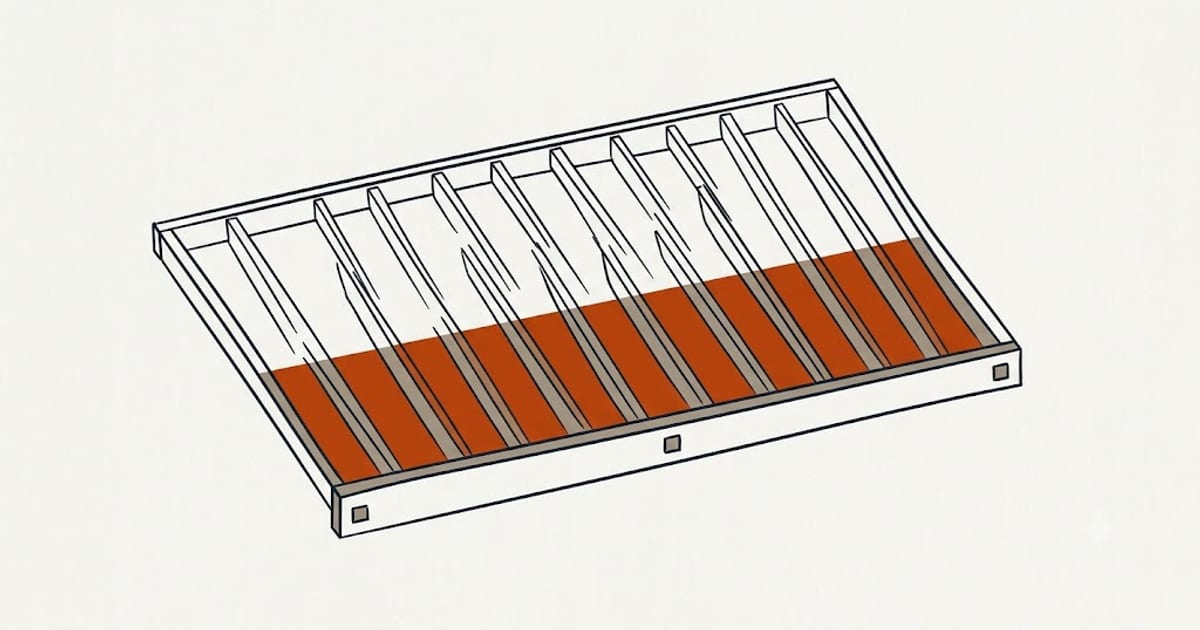
Beam span tables confuse people because they have two inputs and most readers supply one.
The first input is the beam itself — species, size, number of plies. The second is the joist span the beam carries, and that is the one that gets skipped, which is why the number people come away with is often several feet wrong in the dangerous direction.
Why the joist span matters
A beam carries the load from half the joist span on each side of it — its tributary width.
A beam at the outer edge of a deck, with a ledger at the house, carries half the joist span: on a 12 ft deck, 6 ft of tributary width. A beam in the middle of a deck with joists continuing past it carries half the span on each side.
Twice the tributary width is twice the load per foot of beam, and a beam under twice the load spans roughly 70% as far. That is the whole reason the table is two-dimensional.
The joist span input in IRC table R507.5 is the full joist span, not the tributary width — the table does the halving for you. Halving it yourself is a common and unsafe error.
Southern pine, from R507.5
Spans between post centres, for a deck at the standard 40 psf live plus 10 psf dead residential load.
| Beam | 6 ft joist span | 8 ft | 10 ft | 12 ft | 14 ft | 16 ft |
|---|---|---|---|---|---|---|
| 2-ply 2×8 | 8'-2" | 7'-1" | 6'-4" | 5'-9" | 5'-4" | 5'-0" |
| 3-ply 2×8 | 10'-3" | 8'-10" | 7'-11" | 7'-3" | 6'-8" | 6'-3" |
| 2-ply 2×10 | 10'-4" | 8'-11" | 8'-0" | 6'-8" | 6'-2" | 5'-9" |
| 3-ply 2×10 | 12'-9" | 11'-1" | 9'-11" | 8'-6" | 7'-10" | 7'-4" |
| 2-ply 2×12 | 12'-2" | 10'-7" | 9'-5" | 8'-7" | 7'-11" | 7'-5" |
| 3-ply 2×12 | 15'-3" | 13'-2" | 11'-9" | 10'-9" | 9'-11" | 9'-4" |
Read one row across and the picture is immediate: a 3-ply 2×10 spans 12'-9" carrying short joists and 7'-4" carrying long ones. Same beam, 40% less span.
Hem-fir and spruce-pine-fir run roughly 10–15% shorter than every figure above. Check the grade stamp on what the yard actually has rather than what you specified.
Reading it in the useful direction
The table is usually consulted backwards. You do not choose a beam and discover the post spacing — you choose a post spacing you can live with, and the table tells you what beam it takes.
Example. A 14 × 20 ft deck, joists running the 14 ft direction, ledger at the house.
Joist span is 14 ft. Read the 14 ft column. To get posts at 8 ft centres — giving three posts on a 20 ft run with a modest overhang — you need at least a 3-ply 2×12 (9'-11"). A 3-ply 2×10 gives 7'-10", so four posts.
Fourth post: one more footing, one more tube, seven more bags of concrete, one more post base and cap — roughly $110 and an extra hole to dig. Upgrading the beam from 2×10 to 2×12 across 20 ft is three boards, about $60.
Here the thicker beam wins. On a deck with expensive footings — deep frost, poor soil, or a helical pile spec — it wins by much more, and the calculation flips only where footings are cheap and lumber is not.
Cantilever at the beam ends
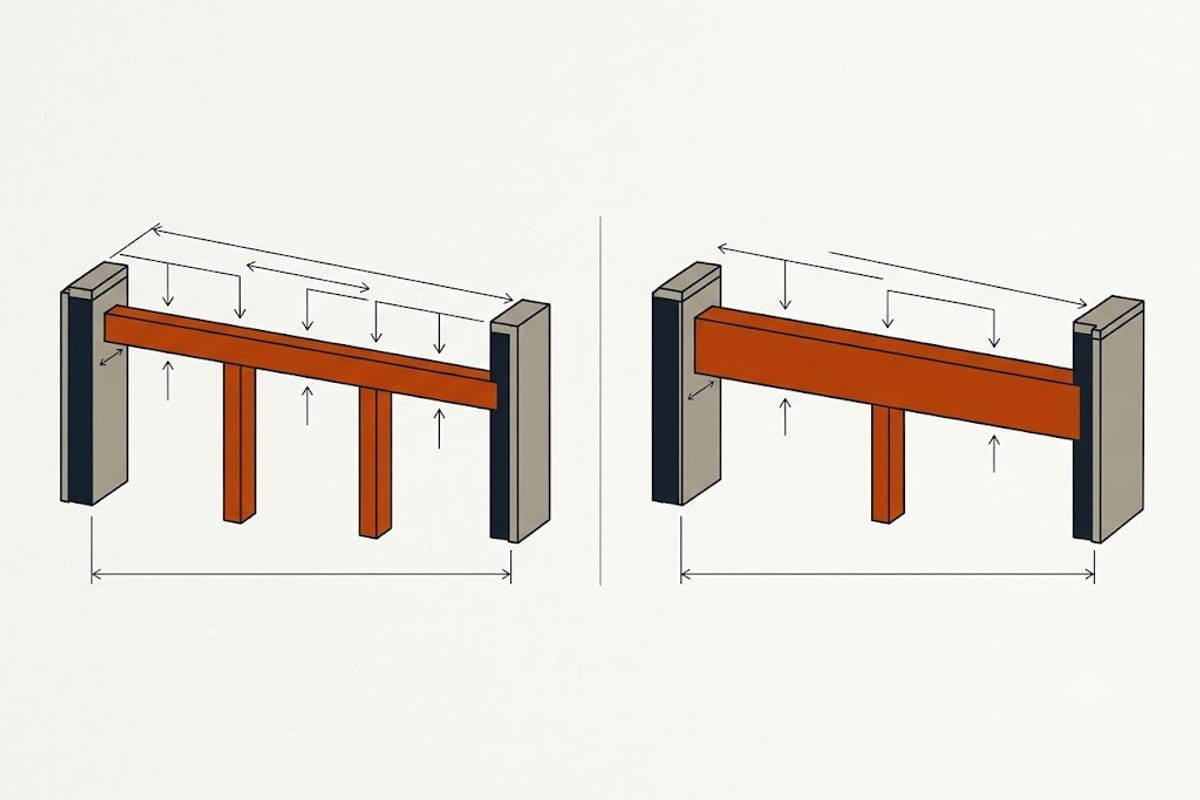
The beam may overhang its end posts by up to one quarter of the adjacent span. On an 8 ft span that is 2 ft of overhang at each end, which turns a 20 ft beam into 16 ft of span between posts plus two 2 ft tails.
That is free span, and it is routinely left on the table. The same rule applies to the joists past the beam, and the two interact — the cantilever rules cover both.
What the table does not cover
A hot tub, a roof, a planter wall, snow load above 40 psf, or a deck carrying a wall. Every one of those is outside the prescriptive table and needs an engineer. The table is written for a residential deck holding people and furniture, and it says so.
Do the two tables together
Beam and joist are one decision. Shorten the joist span and every beam gets longer; lengthen it and every beam shrinks. Start from the joist span table, pick a layout, then price the two options — the framing take-off shows what a post actually costs once its footing is counted.