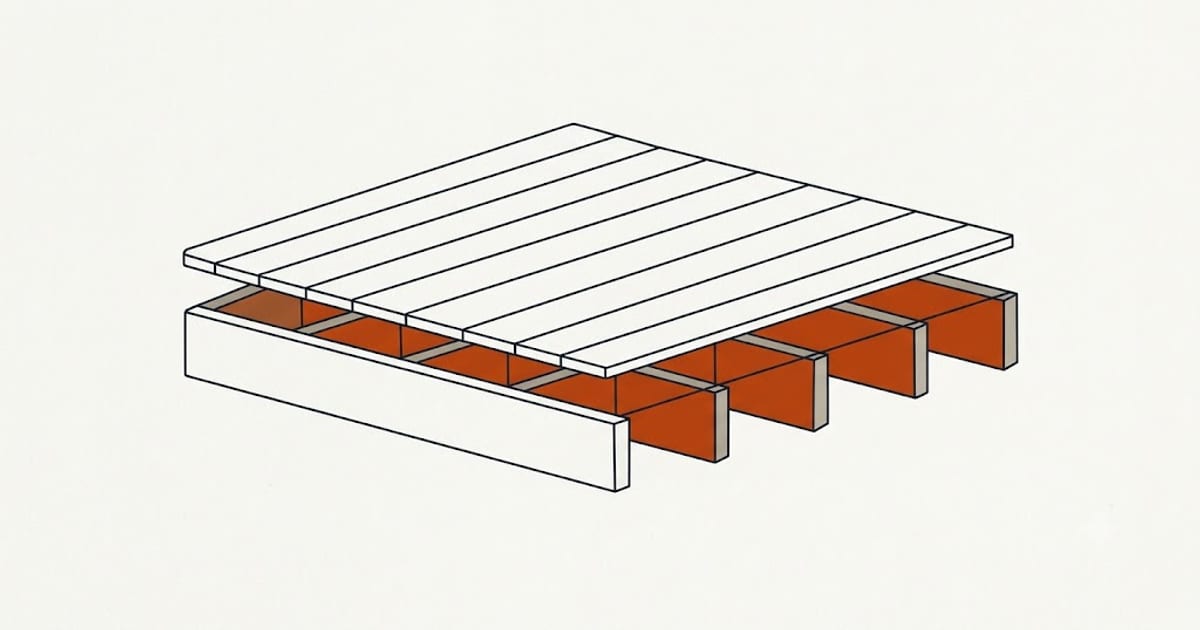
Decking wears out faster than the frame under it. Boards sit in the sun and the rain on all sides; joists sit in the shade and shed water. It is normal for a deck to need new boards at year twelve and have a frame good for another fifteen.
Resurfacing takes advantage of that, and it saves real money — when the frame deserves it.
What it costs
For a 12 × 16 ft deck, 192 square feet, boards and fasteners only, over an existing frame:
| Decking | Material / ft² | Material total | Labour | Total |
|---|---|---|---|---|
| 5/4 PT pine | $2.10 | $403 | $1,150 | $1,553 |
| Cedar | $3.80 | $730 | $1,150 | $1,880 |
| Composite, entry | $4.60 | $883 | $1,350 | $2,233 |
| Composite, capped | $7.20 | $1,382 | $1,350 | $2,732 |
| Hardwood (ipe) | $9.50 | $1,824 | $1,700 | $3,524 |
A full rebuild of the same deck — tear-out, new frame, new footings, new boards, new rail — runs $6,500–11,000. Resurfacing is 40–60% of that, and it is a two-day job rather than a two-week one.
Add roughly $300–500 if the railing is being replaced at the same time, which it usually should be, because a new deck surface makes a twelve-year-old rail look exactly its age.
Whether the frame can take it
Five checks, in the order that kills the idea fastest:
1. The ledger. Pull a deck board at the house wall and look. If the ledger is nailed rather than bolted, or there is no flashing above it, or the sheathing behind it is soft — stop. That is a rebuild, and a safety issue, not a resurfacing job.
2. Post bases. Probe the bottom 6 in of each post with a screwdriver. Posts set directly into soil, or above-ground-rated lumber used at grade, rot from the bottom and look fine from three feet away.
3. Joist tops. This is where resurfacing decks actually fail. Water sits in the fastener holes along the top edge of each joist for twelve years. Probe every joist along its top edge, especially within 2 ft of the ledger. Soft tops mean new fasteners have nothing to bite.
4. Joist spacing against the new board. A frame built at 16 in on centre takes PT and cedar fine. Most composite requires 16 in for perpendicular installation and 12 in for a 45° diagonal layout, and some capped-polymer boards require 12 in outright. A 24 in frame rules out composite entirely without sistering.
5. Hardware. Galvanised hangers installed before 2004 may be under-rated for modern ACQ-treated lumber, which is more corrosive than the old CCA. Rusty hanger nails are a replace-now item and cost almost nothing at this stage.
The upgrade worth doing while it is open
Joist tape. A self-adhesive butyl strip along the top of every joist, $0.35–0.60 per linear foot. On this deck that is 13 joists × 12 ft = 156 ft, about $70 of material and an hour of work.
It seals every fastener penetration and it is the single highest-return item in the whole job — it is the difference between the frame lasting another fifteen years and the frame being the reason you rebuild in ten. It can only be done with the boards off.
When resurfacing stops making sense
If two or more of the five checks fail, the frame is consuming the saving. Sistering joists, replacing posts and re-bolting a ledger inside an existing deck footprint is slow, awkward work that costs more per hour than building new.
The rough rule: once frame repairs exceed 30% of a rebuild, rebuild. You get new footings sized to current soil and load rules, a frame laid out to current span tables, and a warranty on the whole thing rather than on half of it.
The board decision is a twenty-year decision
Resurfacing in PT costs $1,553 and buys 12 years. Resurfacing in capped composite costs $2,732 and buys 25 with no staining. That is $129 a year against $109 a year — and the composite deck never needs a weekend of sanding and sealing.
The full arithmetic, including the stain and seal cycle that PT quietly demands, is in the twenty-year comparison. Fasteners and gapping are their own decision — gap spacing differs by material and getting it wrong on composite causes buckling in the first hot summer.